How to Set Up a Productive Work-From-Home Office That Boosts Focus Fast
You know the struggle: distractions at home steal focus, and your workspace ends up shrinking your potential. You’ll learn how to build a clear, comfortable home office that helps you focus, feel better physically, and get more done each day. This article shows simple, proven steps so your space supports deep work instead of fighting it.

Think of this as practical coaching from someone who’s set up dozens of productive home offices. You’ll avoid common mistakes—like poor lighting, bad posture, or chaotic cables—and get a clear path to a quieter, ergonomic, and tech-ready setup. Expect real examples and straightforward tips that make your next workday smoother and more productive.
1) Dedicated quiet room or corner with door for separation
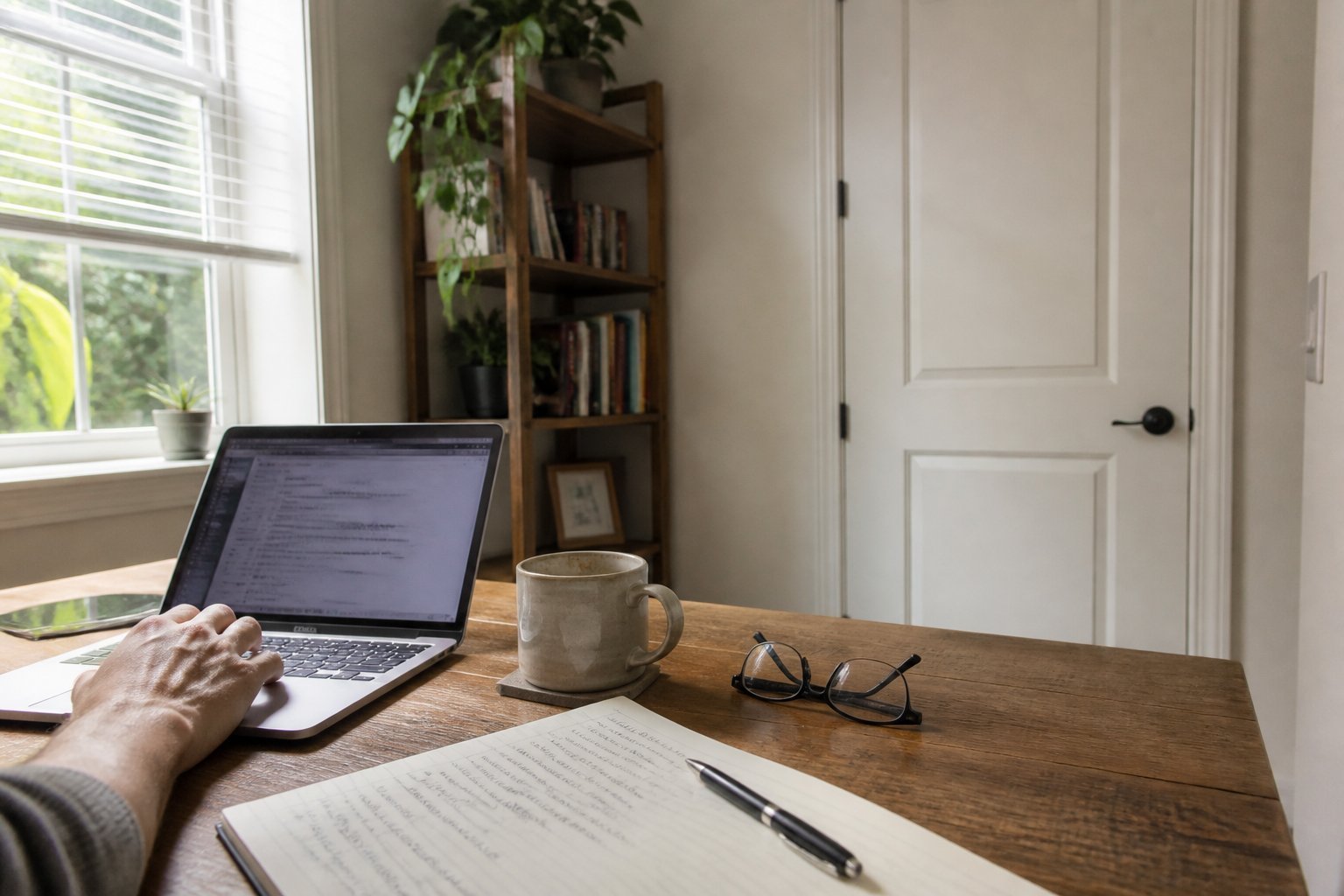
Set the intent: guide. Choose a real room or carve a corner with a door to signal work time and stop household blur. A closed door creates a clear boundary that helps your focus and tells others when you’re unavailable.
Pick a spot with natural light and room for a chair and desk. Avoid high-traffic paths; placing the desk with your back to the room entrance is a common mistake that invites distraction.
Keep essentials within arm’s reach and hide clutter in baskets or a slim cabinet. For small spaces, use a folding screen and a solid curtain to mimic a door—this still creates mental separation.
Test your setup for a week and tweak light, chair height, or where devices sit. If noise leaks, add a rug or door sweep. Try it today and notice how work feels different.
2) Height-adjustable standing desk (e.g., Fully Jarvis Bamboo)
Intent: guide. Choose a standing desk to reduce sitting time and improve focus. A height-adjustable desk like the Fully Jarvis Bamboo lets you switch between sitting and standing in seconds.
Start by setting heights for your most-used tasks. Your elbows should sit at 90 degrees when typing; your screen top should be at eye level. Test settings over a week and note which heights feel best for calls, writing, and focused work.
Common mistake: raising the desk too high and hunching. Use a monitor arm or riser so your neck stays neutral. The bamboo top resists scratches and looks warm on video, which helps during client calls.
If assembly feels hard, follow the official assembly manual and instructions. Try short standing intervals first and build up to longer sessions. Adjust often—small tweaks make a big productivity difference.
3) Ergonomic chair (e.g., Herman Miller Aeron)
This is a guide to picking and tuning a chair so you can sit comfortably for long work sessions. Choose a chair with adjustable lumbar support, seat height, and tilt so you match it to your body.
Sit back and adjust the lumbar to support the natural curve of your lower back. If you feel pressure at the hips, raise or lower the seat until your knees sit at about hip level.
Test the tilt and tension while typing and leaning back. A common mistake is locking the tilt too stiff; allow some recline so you shift posture during the day.
If you want step-by-step help, Herman Miller shows how to adjust an Aeron chair with clear visuals. Try small changes and work with them for a few days before adjusting again.
4) Dual-monitor setup (27″ 1440p IPS monitors)
Guide: set up two 27″ 1440p IPS monitors for a clear, consistent workspace. Start by matching resolution and panel type so color and scaling stay even across both screens.
Place the monitors on a single dual-arm mount to align heights and reduce neck strain. Tilt them slightly inward so your eyes sweep naturally; this cuts mouse travel and improves focus.
Connect with the best cables your laptop or GPU supports—DisplayPort or HDMI—and set the main display in your OS. A common mistake is mixing 1080p with 1440p; it creates uneven scaling and wasted space.
Use one screen for your main app and the other for reference windows, chat, or video calls. If colors matter, run a simple calibration; inexpensive colorimeters fix obvious mismatches quickly.
Try this setup for a week and tweak brightness and layout until it feels effortless. For mounting and step-by-step tips, see a practical dual-monitor guide.
5) External keyboard and mouse (Logitech MX Keys + MX Master 3)
Guide: set up for comfort and speed. Pair the MX Keys and MX Master 3 via Bluetooth or the Logi Bolt receiver so you can switch devices without fuss. For step-by-step pairing, follow Logitech’s MX Keys setup page (https://hub.sync.logitech.com/mx-keys).
Place the keyboard flat or on a slight incline to ease wrist strain. The low-profile keys give steady feedback; try lowering screen height first if you still reach too much. Common mistake: keeping the laptop too high or the keyboard too close.
Map the mouse buttons for your top tasks, like app switching and copy/paste. Use Flow if you work across two computers; it moves the cursor and keyboard input between machines seamlessly. Test for a day and tweak sensitivity until scrolling and gestures feel natural.
6) Noise-cancelling headphones (Sony WH-1000XM5)
Intent: guide — pick headphones that cut distractions and fit your routine.
Choose the WH-1000XM5 if you need reliable noise cancellation for deep work. They block steady noise well and stay comfortable for long calls and focus sessions.
Set them to “Adaptive Sound Control” in the app and let them shift modes between home and calls. A common mistake is leaving Speak-to-Chat on; it pauses audio when you speak and can interrupt focus.
Use them wired for the lowest latency during video editing or live meetings. Battery lasts long, but charge before big days to avoid mid-task panic.
Try one-hour focus blocks with them, then step outside for a short reset. If your workspace is small, they’ll save you from household noise and help signal others you’re working.
Learn quick setup steps in Sony’s official WH-1000XM5 help guide for firmware and app tips: Sony WH-1000XM5 Help Guide.
7) Task lighting with adjustable color temperature (BenQ e-Reading LED)
Intent: guide. Use a lamp that shifts color temperature so your light matches the task and time of day.
Place the BenQ e-Reading LED so its curved head lights your work area without glare on screens. You can switch to cooler white for focused work and warmer light for late‑day reading.
A common mistake is aiming light straight at your eyes. Angle the lamp to wash the desk evenly; this reduces eye strain and screen reflections. The built‑in ambient sensor can auto‑adjust, but test manual settings first to learn what feels best for you.
Try cooler tones (5000–6500K) for data entry and warmer tones (3000–4000K) for creative work. If you want, read the BenQ product page for full features and setup tips.
8) Cable management system (cable tray + Velcro ties)
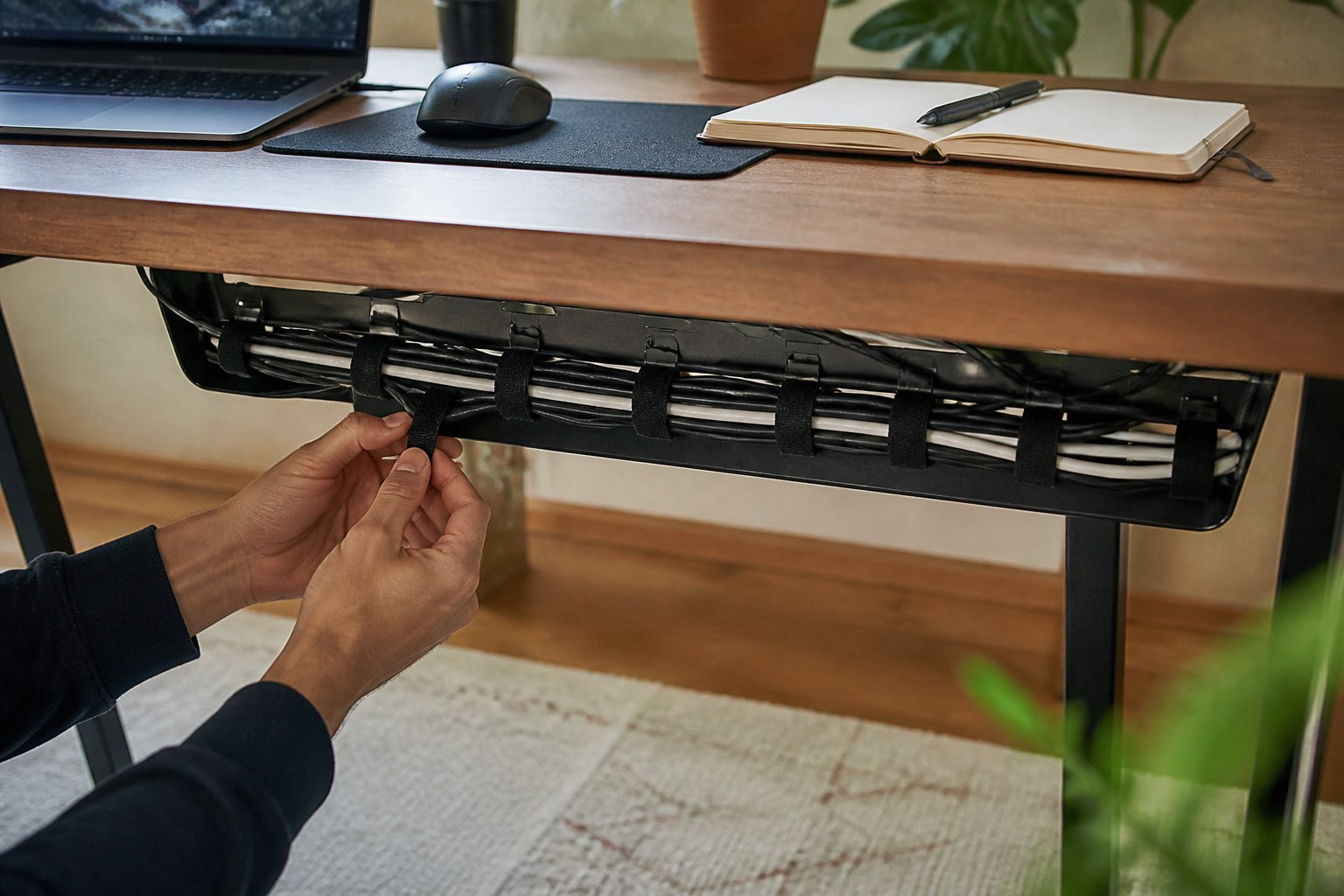
Guide: set up a tidy cable route that stays put when you move. Start by mounting an under-desk cable tray for power strips and bulky adapters; it keeps things off the floor and out of sight.
Use Velcro ties to group cords by device and leave small loops for movement. For a standing desk, secure cables to the desk spine and add a slack loop so the cords never pull tight when you raise or lower it.
Common mistake: bundling everything tight makes heat buildup and makes swapping gear hard. Label the ties or use color coding so you can unplug one device fast.
Try one tray and a pack of Velcro ties first. You’ll notice fewer trips over cables and a cleaner workspace in minutes.
9) High-speed router (Wi‑Fi 6, e.g., ASUS RT-AX86U)
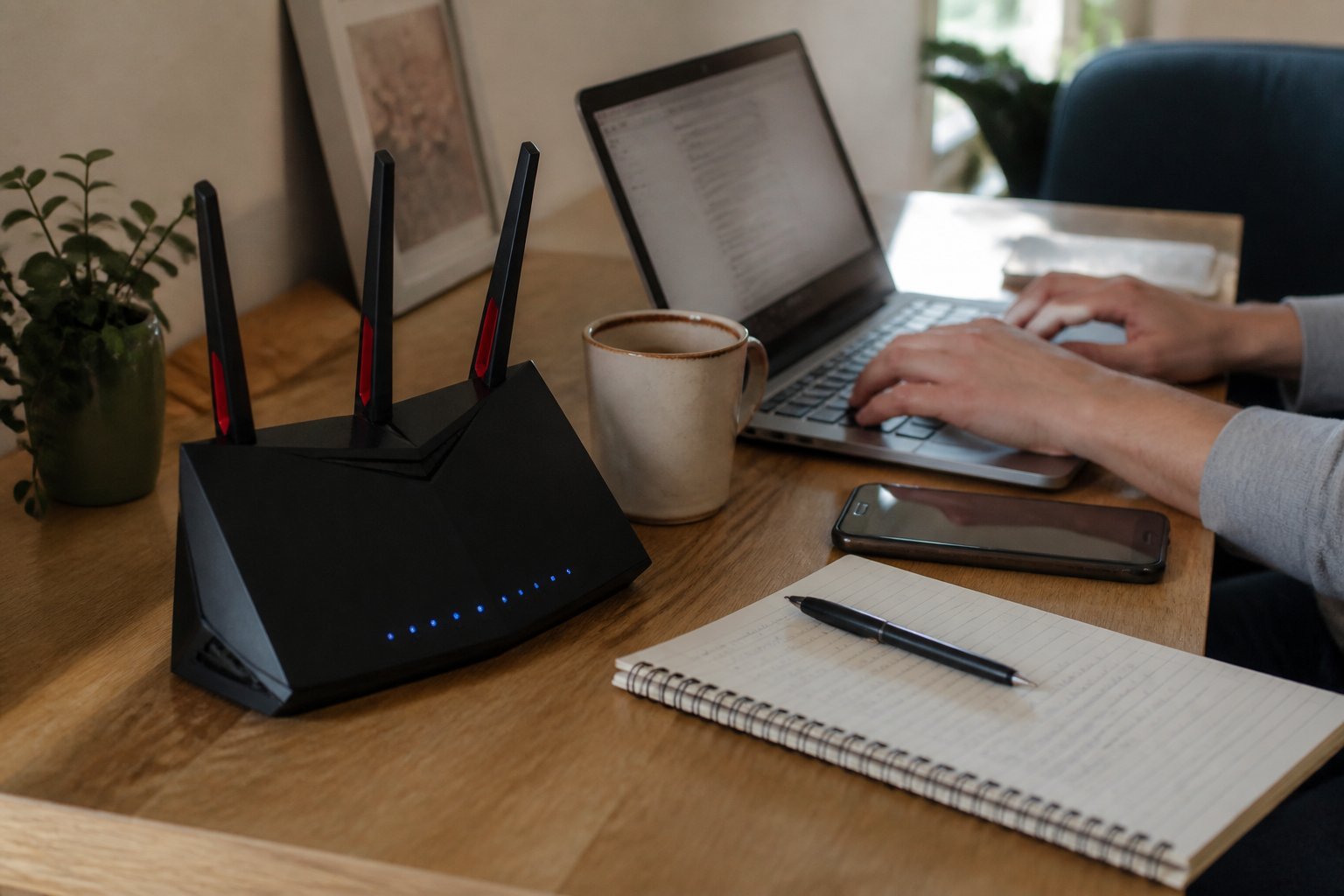
Set the intent: guide. You need a fast, reliable router to avoid slow video calls and lag during screen sharing. Choose a Wi‑Fi 6 model like the ASUS RT-AX86U for better range and more stable connections.
Place the router near your work area, not tucked in a closet. Walls and appliances block signals; moving it a few feet can cut packet loss and dropouts. If you have many devices, enable QoS or a dedicated gaming/streaming port to prioritize your work traffic.
A common mistake is keeping default firmware and passwords. Update firmware and change admin credentials right away. If your home layout still has dead zones, add an AiMesh node or wired access point for consistent speed.
Test speeds with wired and wireless connections after setup. If calls still stutter, check for ISP issues or channel congestion before buying new hardware.
10) Dedicated work calendar and time-blocking routine
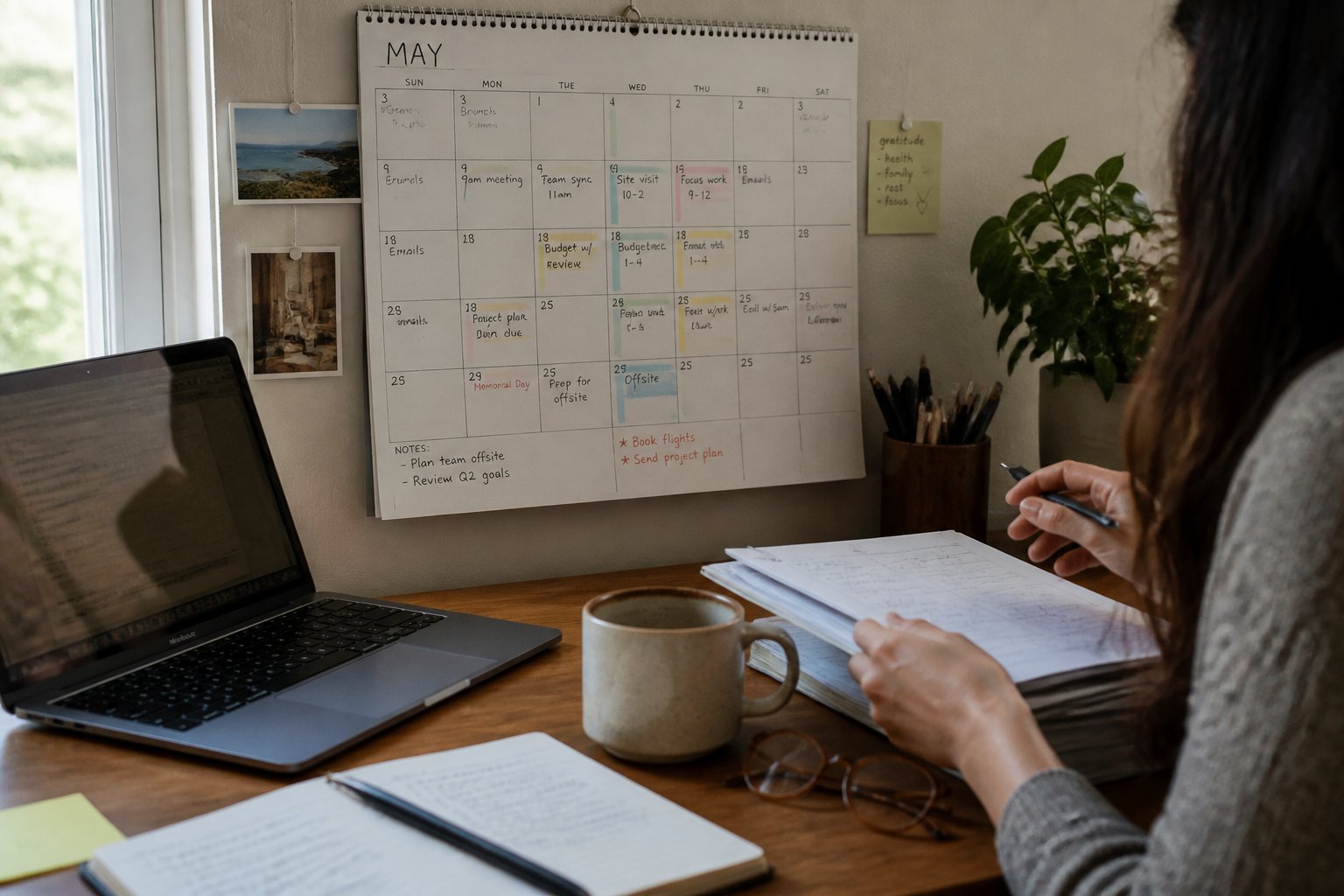
Set a clear intent: build a calendar that protects deep work and predictable hours. Treat your calendar like a contract you keep with yourself and others.
Block focused work first—two to three solid blocks for complex tasks. For example, schedule a 90-minute design block at 9:00 a.m., then a short admin block after lunch. This prevents meetings from eating your best hours.
Label blocks with purpose, not vague tasks. Use tags such as “Deep Writing” or “Client Calls” so you decide quickly what to start. Color-code consistently so your brain recognizes patterns.
Watch for common mistakes: over-blocking every minute or leaving no buffer for interruptions. Add 10–15 minute transition blocks to reset. Review and adjust weekly to keep the routine realistic and yours.
Work-From-Home Ergonomics
Set up your workspace so your body stays comfortable and your focus lasts all day. Small changes to chair height, screen angle, and keyboard placement cut pain and boost steady productivity.
Choosing the Right Chair
Intent: guide. Pick a chair that supports your spine and fits your work habits.
Choose a chair with adjustable seat height, lumbar support, and armrests. Your feet should sit flat on the floor or a footrest, with knees at about a 90° angle. Adjust the lumbar support so it fills the curve of your lower back; if the chair lacks support, add a small lumbar pillow. Tilt the seat slightly forward to reduce pressure on your hips if you sit long hours.
Watch common mistakes: chairs that look stylish but lack adjustments, or armrests set too high that raise your shoulders. Test the chair for 10–15 minutes before committing. If you switch between desk and standing, use a chair that reclines easily and locks at multiple angles.
Screen Positioning and Eye Health
Intent: tutorial. Place screens to keep your neck neutral and reduce eye strain.
Set the top of the monitor at or just below eye level so you look slightly downward at the screen. Position the monitor about an arm’s length away (roughly 20–30 inches) depending on screen size and your vision. Tilt the screen back 10–20 degrees to avoid glare. Use a separate monitor or laptop stand if needed.
Reduce eye strain with the 20-20-20 rule: every 20 minutes, look at something 20 feet away for 20 seconds. Dim overhead lights and use indirect task lighting to lower contrast and glare. If you wear glasses, consider an anti-reflective coating or a screen with adjustable color temperature.
Productivity Habits in a Home Office
Set a clear work rhythm and protect focused time. Small routines and smart boundaries help you finish work faster and keep evenings free.
Setting Consistent Work Hours
Intent: guide you to create hours that fit your day and boost output.
Decide on fixed start and stop times and add them to your calendar. Treat those blocks like meetings you cannot skip. Use a visible clock or a calendar widget so you and others know when you’re “at work.”
Build a 15-minute morning ritual: check priority tasks, open one document, and close email until after your first deep task. This signals your brain to switch into work mode.
Schedule 90–120 minute focus blocks with 10–15 minute breaks. Long stretches without breaks lower quality. Log how long each task actually takes for one week and adjust your blocks to match real effort.
Tell household members your hours and post a simple sign or status on messaging apps. When people respect your schedule, interruptions drop. If your job needs flexibility, define core “overlap” hours where you must be available.
Minimizing Distractions
Intent: teach practical ways to cut interruptions and keep focus.
Start by removing visual clutter from your desk: only keep the current task, a notebook, and one pen. Clutter pulls attention and slows you down.
Use a site blocker for known time-sinks and set your phone to Do Not Disturb during focus blocks. Put your phone face down in another room when possible.
Create an “interruption plan” for the household: a simple red/green sign, or agreed quiet hours, and quick signals for true emergencies. Practice this for a week and tweak rules that don’t work.
When a distraction hits, write it on a quick capture list and return to work. This prevents spending minutes re-focusing and keeps your task list intact.
For meetings, share a short agenda and a time limit. Back-to-back calls without goals create context-switch fatigue; keep meetings 25–50 minutes to preserve focus time.